
Recovery and the nervous system
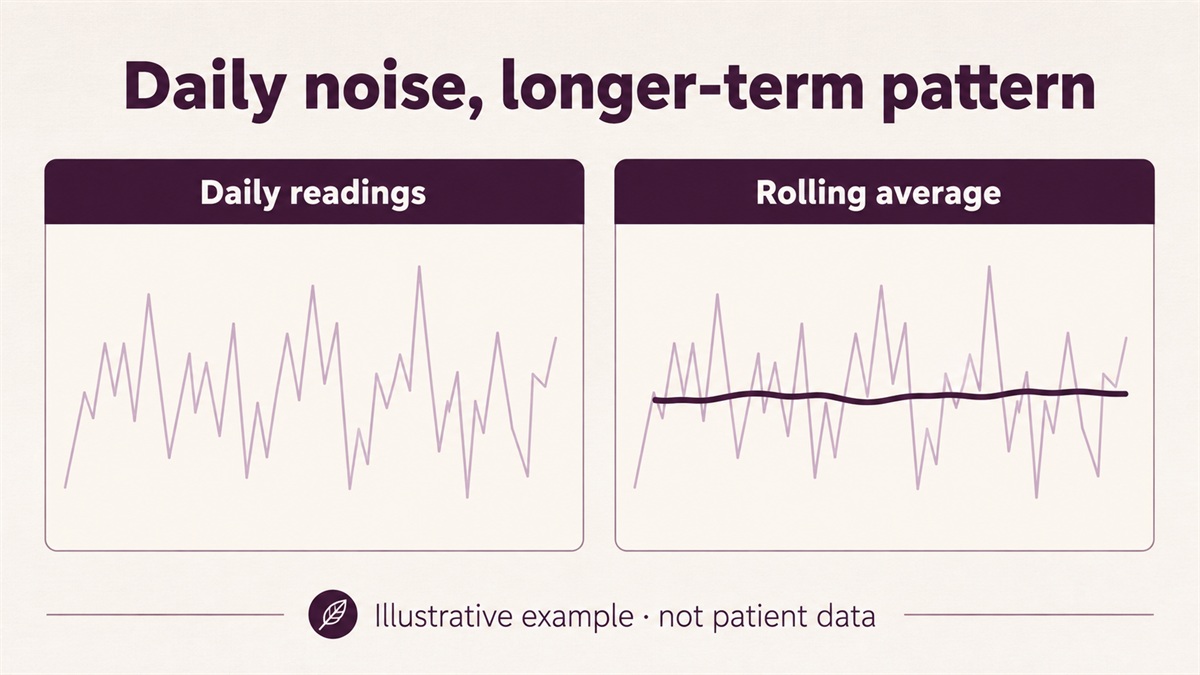
Your HRV swings 20 to 40 percent day to day. That is normal.
Heart rate variability is a genuinely useful signal read over weeks and a nearly useless one read every morning.

Heart rate variability became the headline recovery metric, and it deserves some of that attention. What it does not deserve is to be read as a daily verdict, because its natural day-to-day variation is far larger than most users realise.
The short version
- Day-to-day variation of roughly 20 to 40 percent is normal in healthy adults.
- Absolute values are not comparable between people; only your own baseline matters.
- A rolling average across a week or more carries the signal. A single morning carries mostly noise.
- Alcohol, late meals, illness, heat, and hard training all move it, often more than training load does.
What it measures
Heart rate variability quantifies the variation in the interval between successive heartbeats. Higher variability generally indicates greater parasympathetic activity, associated with a rested, recovered state. Lower variability suggests sympathetic dominance from stress, illness, or fatigue.
The relationship is real and reasonably well established. What complicates it is how many things influence the same number.
Why single readings mislead
Healthy adults commonly see day-to-day swings of twenty to forty percent. That range means a morning reading well below yesterday's can be entirely unremarkable.
Measurement conditions add more. Body position, time since waking, breathing rate during the reading, room temperature, and sensor fit all move the result. Devices that measure across the night are somewhat more stable than a spot reading, but the underlying variability remains.
And absolute values differ enormously between individuals for reasons including age and genetics. Comparing your number to someone else's, or to a population figure from an article, tells you nothing.
Reading it usefully
Establish a baseline over at least two weeks, changing nothing. Then watch the rolling average rather than the daily value. A sustained downward drift across a week or more, particularly alongside worse sleep and higher resting heart rate, is a signal worth acting on.
A single low morning is a single low morning. Train as planned, or do not, based on how you feel, which remains a decent instrument.
Common questions
What is a good HRV?
There is no population target that means anything for you. Your own baseline and its trend are the only useful reference.
Why did mine crash after one drink?
Alcohol reliably suppresses HRV overnight, often substantially. It is one of the most consistent single-night effects people observe.
Sources
- AI health wearables in 2026 — https://www.aimagicx.com/blog/ai-health-wearables-smart-rings-monitors-guide-2026
- Wearable tech and biometric guide — https://ethicalbiohacking.com/wearables