
Sleep architecture
Sleepmaxxing built an industry on top of advice that costs nothing
The trend brought welcome attention to rest. It also stacked genuinely supported practices with unsupported ones and sold the whole bundle at once.
Sleepmaxxing describes the pursuit of optimal sleep through layered supplements, trackers, cooling systems, mouth tape, and increasingly elaborate routines. The Global Wellness Institute named it as a defining trend of 2026, and its assessment was mixed for good reason.
The short version
- A 2025 survey found roughly 45 percent of Americans engaging in sleepmaxxing practices, led by Gen Z at 48 percent, with women more likely to participate than men.
- Spending is real but uneven: an average of about 75 dollars a year, with around 8 percent spending 500 dollars or more.
- The best-supported elements, consistent timing and light management, cost nothing.
- Sleep hygiene alone consistently underperforms structured cognitive behavioural therapy for insomnia, which almost nobody in the trend is discussing.
What the trend gets right
At its core, sleepmaxxing reflects a genuine improvement in public understanding. More people now treat sleep as foundational rather than as time that could be spent doing something else. That is a real cultural shift and it is worth defending.
Several of the bundled practices are well supported. Schedule consistency has strong cohort evidence behind it. Light management has a clear mechanism: evening light exposure delays circadian phase and suppresses melatonin. A 2025 meta-analysis found sleep hygiene education produces meaningful improvements in self-reported sleep quality, especially combined with other behavioural work.
Where it goes wrong
The problem is bundling. A stack containing a supported practice, a plausible one, and an unsupported one gets promoted as a single protocol, and any benefit gets attributed to the whole. That is how mouth taping ends up recommended alongside keeping a consistent bedtime.
It also gets complicated in a way that works against itself. A wind-down routine with eleven steps is a routine that will be abandoned, and abandoning it generates its own frustration. The interventions with the best evidence are short, dull, and repeatable.
Then there is the tracking layer, which for a subset of people actively causes harm. That has a name and its own literature, and we cover it separately.
The premise is sound. Sleep quality and duration have measurable health consequences. The specific stacks promoted online are a separate question entirely.
Althermia
Grading the common elements
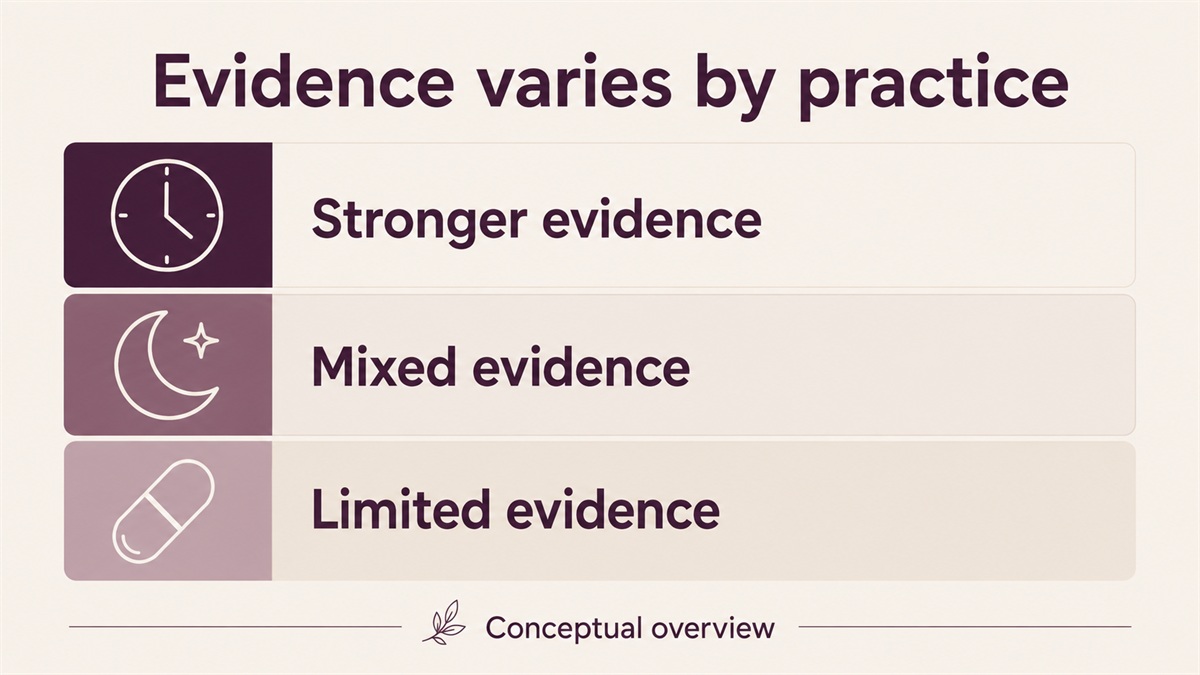
Strong. Consistent sleep and wake timing across all seven days. Adequate opportunity for sleep. Treating diagnosed sleep apnoea. Cognitive behavioural therapy for insomnia where insomnia is present.Moderate. A cool bedroom, since core temperature needs to fall for sleep onset. Darkness and evening light reduction. Limiting alcohol, which reliably fragments the second half of the night. Caffeine timing.Limited. Most bedtime supplements, individually. Magnesium and L-theanine have some supporting work and modest effect sizes. Tart cherry and apigenin have less.Anecdotal. Mouth taping, elaborate multi-step rituals, most sleep-branded beverages, and anything sold primarily on the promise of a better tracker score.The intervention nobody is selling
Cognitive behavioural therapy for insomnia is the first-line treatment for chronic insomnia in every major guideline. It outperforms sleep hygiene advice, outperforms medication over the long term, and its effects persist after treatment ends.
It also requires several weeks of structured work, including deliberately restricting time in bed, which feels wrong before it starts feeling right. It cannot be sold as a supplement, which is a large part of why it barely appears in the conversation.
If you only change three things
Every day, including weekends. Wake time anchors the circadian system more firmly than bedtime does, and regularity has independent cohort evidence behind it.
Core temperature has to drop for sleep onset. A cooler room and genuine darkness support that. This is cheap and both have plausible mechanisms.
Two or three repeatable cues beat eleven steps you will abandon. Consistency is the active ingredient in a wind-down routine, not the contents.
Common questions
Is any of the sleepmaxxing stack worth buying?
Blackout curtains and a way to cool the room are defensible. Beyond that, spend on professional help before spending on products, particularly if you have insomnia.
What about mouth tape?
It is one of the most viral and least supported practices in the category, and clinicians raise safety objections particularly for anyone with undiagnosed obstructive sleep apnoea. We have a full piece coming.
How do I access CBT-I?
Through a clinician, a behavioural sleep medicine specialist, or one of several structured digital programmes with trial evidence behind them. Ask your doctor what is available where you live.
Sources
- Sleep initiative trends for 2026, Global Wellness Institute — https://globalwellnessinstitute.org/global-wellness-institute-blog/2026/03/30/sleep-initiative-trends-for-2026/
- Sleepmaxxing: practices and evidence — https://superpower.com/guides/emerging-health-topics/sleepmaxxing-trend-practices-evidence-based
- Sleep trends 2026 optimisation guide — https://mattressmiracle.ca/blogs/mattress-miracle-blog/sleep-trends-2026-optimization-guide