
Evening protocols
Grading the bedtime supplement stack
Magnesium, L-theanine, apigenin, tart cherry and the rest, sorted by how much human evidence sits behind each.
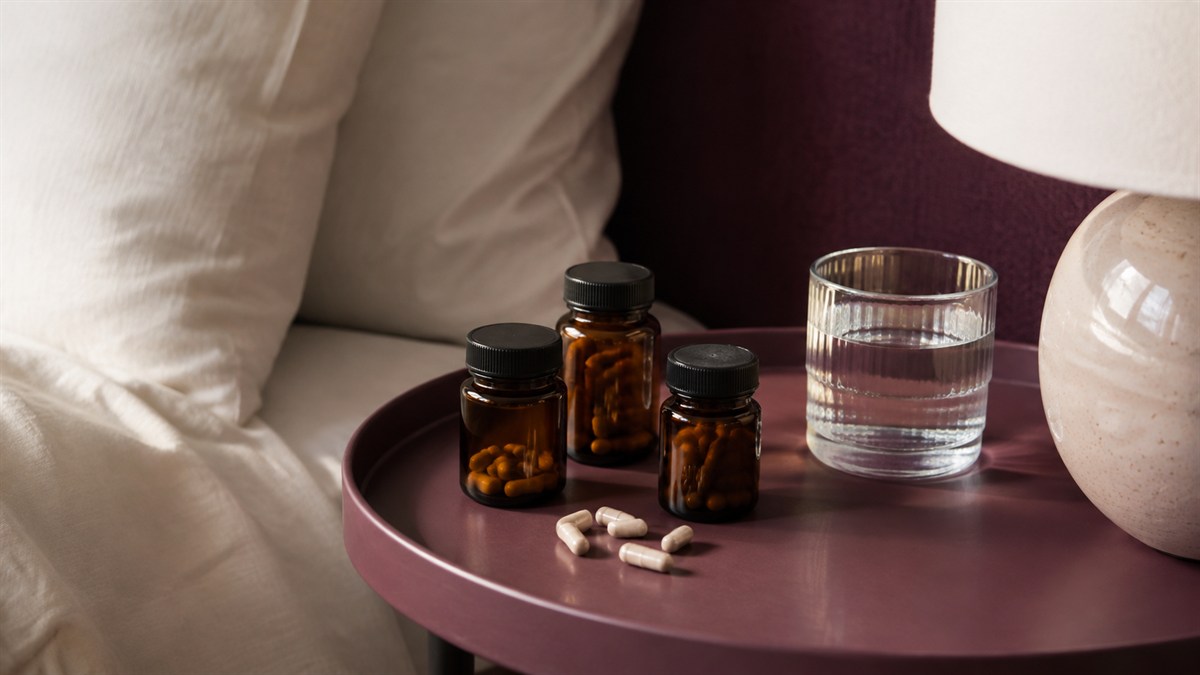
A typical bedtime stack now contains four to six ingredients. Some have modest supporting evidence. Some are there because they appeared in a video. Taken together, they make it impossible to know what, if anything, is helping.
The short version
- Magnesium glycinate is commonly used at 200 to 400 milligrams in the hour or two before bed, and it is among the better-tolerated forms.
- L-theanine is associated with reduced subjective arousal without sedation, with modest effect sizes.
- Effect sizes across this category are generally small compared with behavioural intervention.
- Adding ingredients one at a time is the only way to learn anything about your own response.
The ones with something behind them
Magnesium is the most commonly used and among the more defensible. Glycinate is the form most often chosen for sleep, largely for tolerability, and typical usage sits in the 200 to 400 milligram range taken an hour or two before bed. The evidence is stronger in people with low intake or deficiency than in people already replete.
L-theanine, an amino acid from tea, has reasonable support for reducing subjective arousal without producing sedation. It does not make you sleepy so much as make it easier to stop being alert, which is a different and sometimes more useful thing.
The ones with less
Apigenin and tart cherry appear constantly in stacks and have considerably less human data behind them at the doses used. Tart cherry has some small trials with mixed results. Apigenin's popularity is largely downstream of podcast coverage rather than trial evidence.
Melatonin deserves its own treatment. It is a circadian signal rather than a sedative, and it is most useful for shifting timing, in jet lag or delayed sleep phase, at low doses taken well before target bedtime. The high doses commonly sold are poorly matched to that purpose.
Every ingredient in a stack of six gets credit for any night that goes well. That is not how you find out whether any of them works.
Althermia
The stacking problem
If you start six ingredients simultaneously and sleep improves, you have learned nothing about which one did it, or whether any did. Expectation alone produces meaningful subjective sleep improvement, which is exactly what these products are measured on.
The alternative is slow and works: fix the behavioural fundamentals first, establish a two-week baseline, then add one ingredient at a time for two to three weeks each. Most people discover that one or none is doing anything.
What outperforms all of it
For chronic insomnia, cognitive behavioural therapy has better evidence than anything in this article, with effects that persist after treatment ends. For everyone else, consistent wake time, a cooler and darker room, and limiting alcohol will move sleep more than the stack will.
None of which is a reason to be dismissive if a supplement helps you. It is a reason to get the order of operations right.
Grading the shelf
Magnesium, particularly where intake is low. L-theanine for reduced arousal. Low-dose, correctly timed melatonin for circadian shifting rather than as a nightly sedative.
Apigenin, tart cherry, glycine, and most proprietary sleep blends. Small trials, mixed results, or doses that do not match the research.
Anything sedating taken nightly, anything alongside prescription medication, and any supplement used to manage a sleep problem that has lasted more than three months.
Common questions
Is melatonin safe long term?
Long-term data in healthy adults is limited, and it is a hormone rather than a nutrient. Most guidance favours short-term, purposeful use for timing problems rather than indefinite nightly use.
Which magnesium form?
Glycinate is the usual choice for sleep on tolerability grounds. Oxide is poorly absorbed and more likely to cause digestive effects.
Do I need a stack at all?
Most people who fix wake time, room temperature, evening light and alcohol find the stack question much less pressing.
Sources
- Sleep trends 2026 optimisation guide — https://mattressmiracle.ca/blogs/mattress-miracle-blog/sleep-trends-2026-optimization-guide
- Sleepmaxxing: practices and evidence — https://superpower.com/guides/emerging-health-topics/sleepmaxxing-trend-practices-evidence-based
- Sleepmaxxing overview — https://en.wikipedia.org/wiki/Sleepmaxxing