
Evening protocols
Evening light, melatonin, and what the blue light claims get wrong
Light exposure before bed has a clear circadian mechanism. The consumer version of that story has become considerably narrower than the science.
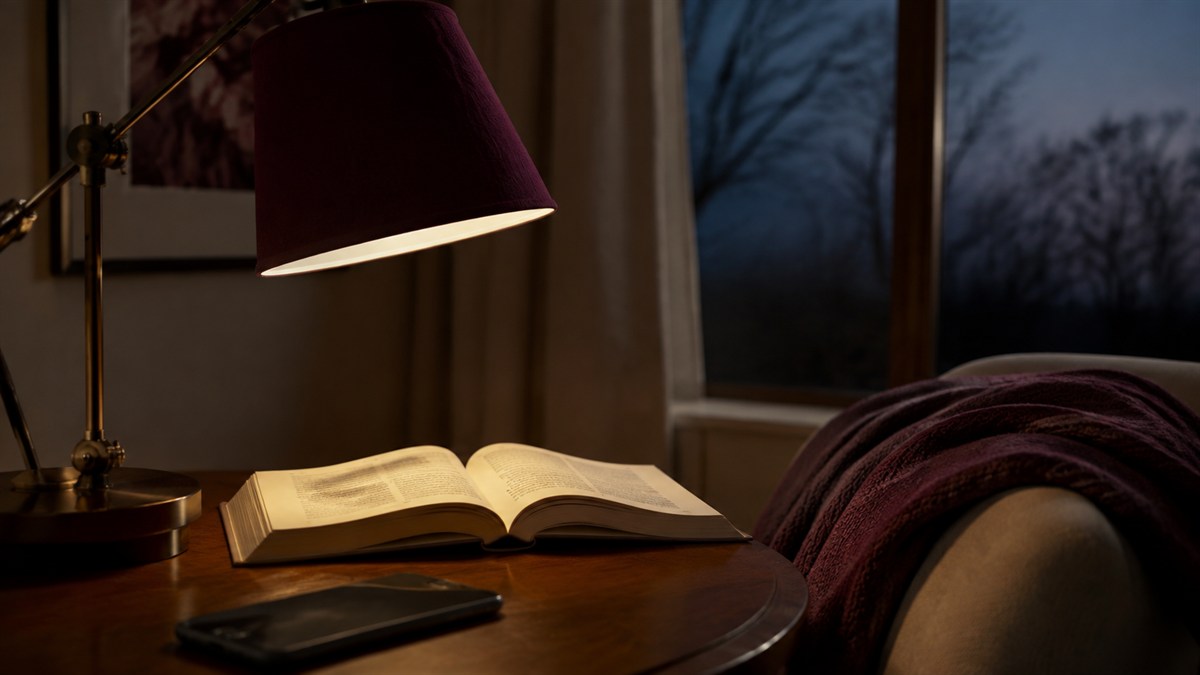
Evening light delays circadian phase and suppresses melatonin. That much is well established. What followed was a product category built on one narrow interpretation of it.
The short version
- Total light intensity and duration matter, not only the blue portion of the spectrum.
- Melanopic illuminance is the more relevant measure, and it is not what most consumer products advertise.
- Turning lights down is more effective than filtering a screen while sitting in a brightly lit room.
- Morning light exposure may matter as much as evening reduction.
What the mechanism actually says
Specialised retinal cells containing melanopsin signal ambient light levels to the circadian clock. They are most sensitive to short-wavelength light, which is where the blue light framing came from, but they respond to overall light intensity, and the relevant quantity is melanopic illuminance rather than any single wavelength.
Research on narrow-band melanopic illuminance and indoor lighting protocols is active, and the practical implication is consistent: a dim warm room beats a bright room with filtered screens.
Where the consumer version drifted
Blue light blocking glasses and screen filters address one component of one source. If you wear amber glasses while sitting under bright overhead lighting, the overhead lighting is doing most of the work on your circadian system.
Screens also tend to be lower intensity than people assume relative to room lighting. A phone at arm's length in a dim room contributes less melanopic exposure than a well-lit kitchen. The behaviour on the screen, and the arousal it produces, may matter more than the photons.
The practical version
Reduce overall light in the two hours before bed. Use lamps rather than overhead lighting, and dim them. If you have controllable bulbs, warm and low beats cool and bright.
Then get bright light early in the day, ideally outdoors. Morning light is the strongest anchor for circadian timing, and it is the half of the equation consumer coverage usually omits because nothing can be sold alongside it.
Common questions
Are blue light glasses useless?
Not useless, but narrower than marketed. Dimming the room is the higher-leverage action.
Does night mode on my phone help?
Marginally. Reducing overall brightness helps more, and putting the phone down helps most, largely for arousal reasons rather than optical ones.
Sources
- Sleepmaxxing: practices and evidence — https://superpower.com/guides/emerging-health-topics/sleepmaxxing-trend-practices-evidence-based
- Home-based light therapy and sleep trial record — https://clinicaltrials.gov/study/NCT07465250